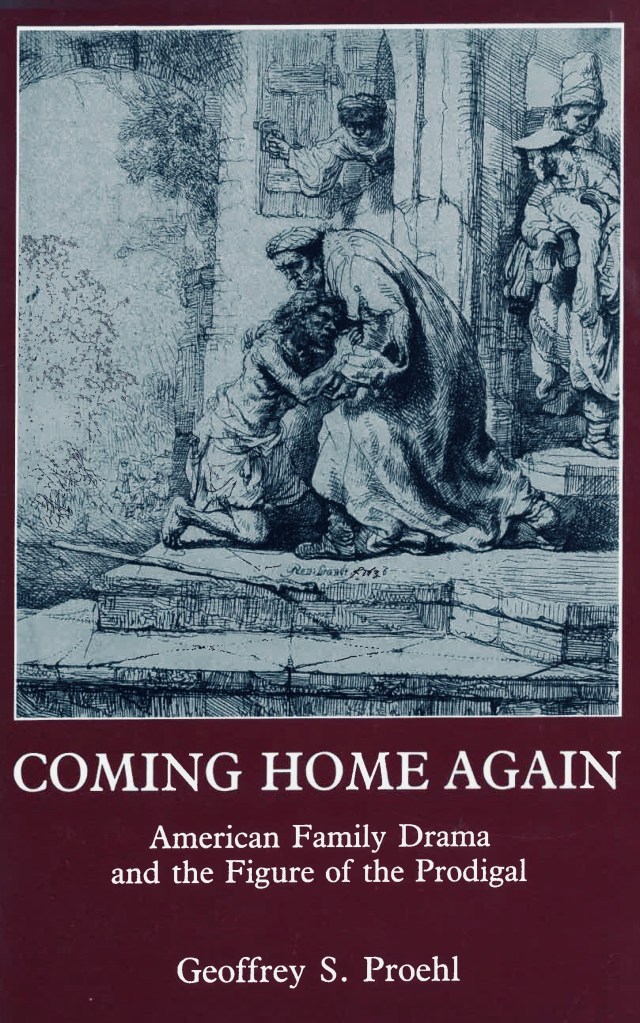
Coming Home Again explores the representation of the family in American drama, in particular, on various uses and conventions of the figure of the prodigal husband or son. It considers the lineage and function of this figure from the writings of Augustine, medieval iconography, Renaissance prodigal son plays, and temperance melodramas to such contemporary manifestations as television talk shows, the Recovery Movement, and plays by contemporary writers including Spalding Gray, Ntozake Shange, and Cherrie Moraga.
It begins, however, with a simple image found again and again in dozens of American plays: the image of a man a man with a bottle, whether sitting in a tavern as in O’Neill’s The Iceman Cometh or at home as in Long Day’s Journey Into Night or one of Sam Shepard’s family dramas. The actor John Malkovich literally pouring beer down his throat as Lee in True West is a fairly typical example. Indeed, the best way to disable structurally the maximum number of American plays, particularly domestic dramas, would be to take from them this image.
The action is simple: a hand carries a bottle or glass to the lips, alcohol passes over lips, down the throat and into the bloodstream, to the brain and back to the body’s surfaces altering, at first subtly and then radically, the drinker’s perceptions and state of being. The action is perhaps too simple, too invisible, and banal to concern many who write about American drama, but once identified, it seems like a national obsession.
In particular, this study examines manifestations of this image from several domestic dramas first performed in the years immediately following World War II. Separate chapters address the role of drinking in American drama, the history of the prodigal as a dramatic convention and its distinguishing characteristics, dramatic uses of brother pairs and doubles, the role of the man or woman who waits for the prodigal’s return, recent variations of the prodigal’s departure and return by both male and female playwrights, and the phenomenon of the sentimental spectator. Chapters generally employ one or more of O’Neill’s late plays to clarify the nature of these functions. These illustrations are then supplemented with references to several other dramas from roughly the same time period: Death of a Salesman, Country Girl, Come Back Little Sheba, Cat on a Hot Tin Roof, Raisin in the Sun, All the Way Home, Come Blow Your Horn, Who’s Afraid of the Virginia Woolf? and others.
Available on Amazon.
 Geoff Proehl, Writer, Pacific Northwest